Description
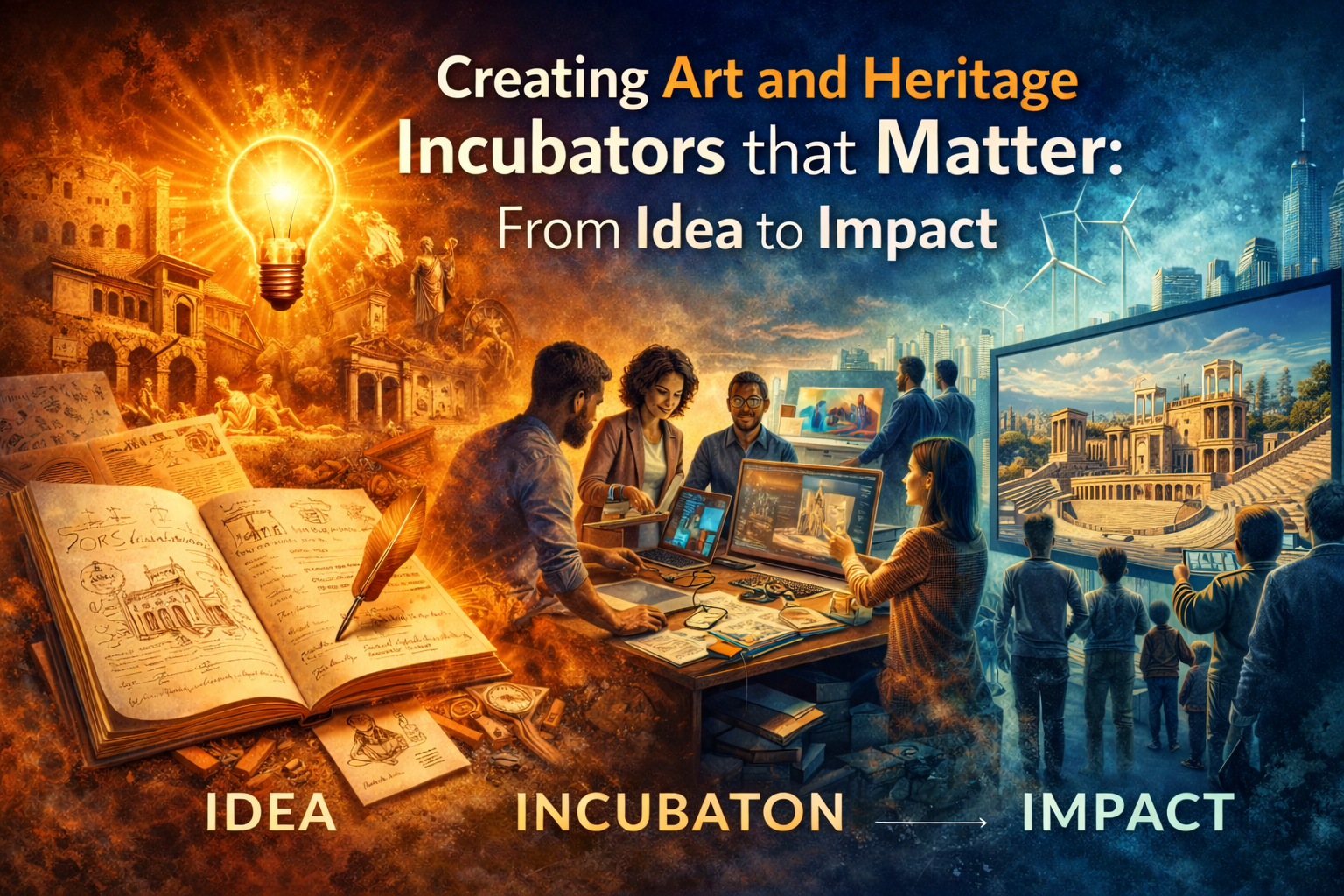
The Blended Intensive Programme “Creating Art and Heritage Incubators that Matter: From Idea to Impact” aims to explore the conceptual, strategic, and operational dimensions of establishing and managing Art and Heritage Incubators within European higher education and innovation ecosystems.
The programme focuses on the H&ART Incubator, a transnational initiative of the KreativEU Alliance, designed to support the generation, incubation, and implementation of innovative ideas, projects, and start-ups in the fields of arts, cultural heritage, cultural and creative industries, and digital transformation.
The BIP will provide participants with an interdisciplinary environment to examine how incubators can support cultural innovation, entrepreneurship, sustainability, and knowledge valorisation, while strengthening collaboration between universities, cultural institutions, creative enterprises, and public stakeholders.
The programme will address key components of the H&ART Incubator ecosystem, including:
- strategic mission, vision, and priorities of the H&ART Incubator;
- governance structure and operational framework of transnational incubators;
- development and maintenance of a Transnational Mentor Pool;
- mentoring models, mentor profiles, and mentoring methodologies;
- artistic residency programmes and creative incubation cycles;
- coaching and capacity-building for artists, students, and start-ups;
- student competitions and innovation challenges;
- stakeholder engagement and involvement methods;
- innovative, experiential, challenge-based, and transnational mobility formats;
- the role of transnational and territorial observatories for cultural and creative industries;
- intellectual property management and knowledge valorisation in the cultural sector;
- sustainability strategies for cultural innovation ecosystems.
The programme aims to strengthen participants’ understanding of how art, heritage, entrepreneurship, and technology can be integrated into sustainable innovation ecosystems across Europe.
Expected Outcomes
By the end of the programme, participants will:
- gain a comprehensive understanding of the structure, strategy, and operation of Art and Heritage Incubators;
- develop knowledge in mentoring, coaching, and supporting creative entrepreneurship;
- understand mechanisms for building and managing transnational mentor networks;
- explore innovative formats such as artistic residencies, creative incubations, and innovation competitions;
- acquire practical insights into IP management and stakeholder engagement and involvement;
- strengthen intercultural and interdisciplinary collaboration across European universities.
Participants will also contribute to discussions on the future development of the H&ART Incubator ecosystem, providing ideas for expanding mentoring structures, stakeholder participation, and sustainability strategies.
Methods
The programme will combine:
- world cafés and expert talks;
- workshops and co-creation sessions;
- roundtable discussions with stakeholders and practitioners;
- site visits and field-based learning activities;
- peer learning and collaborative problem-solving.
The virtual component will take place after the physical mobility and will serve to consolidate the knowledge gained during the on-site programme, support continued collaboration among participants, and further develop the ideas and project concepts generated during the intensive week.
The online sessions will provide a space for reflection, follow-up discussions, and deeper exploration of the strategic and operational aspects of the H&ART Incubator within the broader cultural innovation ecosystem of the KreativEU Alliance.
During the virtual phase, participants will work in international collaborative groups to develop a practical concept for implementation in their local institutional context. Each group will design one of the following:
- a mentoring programme for supporting incubatees within their local H&ART branch;
- an artistic residency programme aimed at fostering experimentation, interdisciplinary collaboration, and cultural innovation;
- a student competition or innovation challenge designed to stimulate creative solutions at the intersection of art, heritage, and technology.
- Trainer: Marusya Smokova
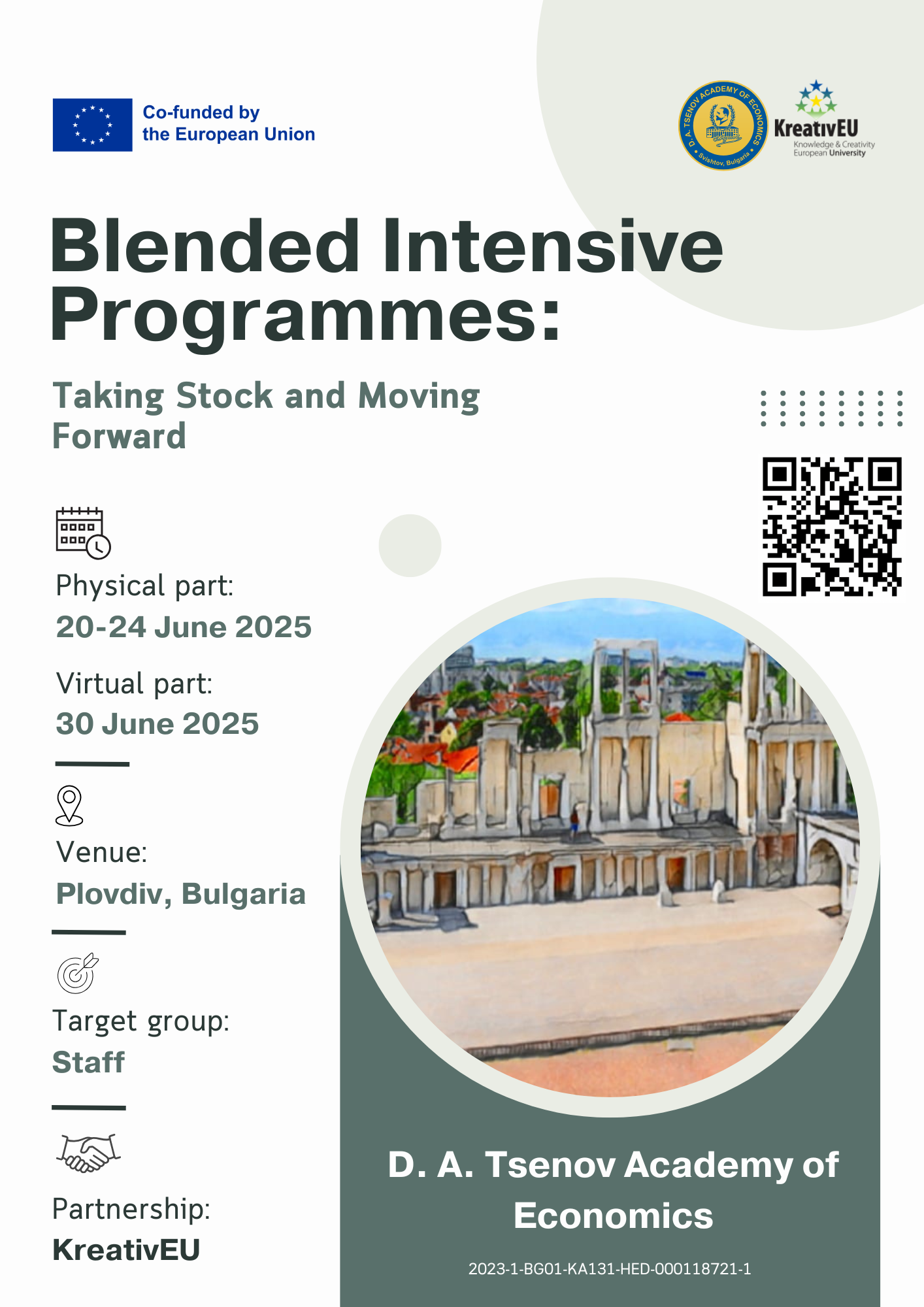
The main objective of the BIP is to identify lessons learnt from past BIPs and alternative events. It will provide participants with tips and guidelines for sustaining strengths and improving weaknesses in planning, designing, implementing, and evaluating BIPs. The BIP is targeted at the academic and administrative staff in HEIs, who are responsible for organising and implementing BIPs. The BIP will be organised as thematic workshops and working groups. The BIP will cover topics that vary from finding the right BIP idea and target group, choosing the role in the BIP partnership, using reliable resources for exploring good practices, composing an effective partnership, describing the BIP, choosing the optimum number of participants, finding the right time and channels to communicate the BIP, choosing the venue, managing IIAs, MAs, and LAs, managing applications and registrations, funding the BIP and providing services to the participants, defining an agenda, hosting the participants, overcoming the obstacles, collecting and analysing participants’ feedbacks, evaluating and reporting the BIP.
The BIP is more applied-oriented and use-inspired, focusing on tips and guidelines on how to organise and implement useful, inspiring, and memorable BIPs. It relies mainly on experiential learning, gamified project-based learning, collaborative learning, and role-playing instructional strategies. Participants could learn through collaboration and experiences, as well as through the exchange of good practices. They will work in teams of 2-3 people and could earn badges for their performance. Each group will evaluate the BIP developed by a peer team.
After the physical training sessions, participants will continue working on their group assignment to design a real BIP. They will be provided access to a Moodle-based course where they can collaborate and present their group assignment. The group presentation will be organised as a final online workshop to sum up the experience and lessons learnt. It will be held on June 30th, 2025.
- Trainer: Marusya Smokova
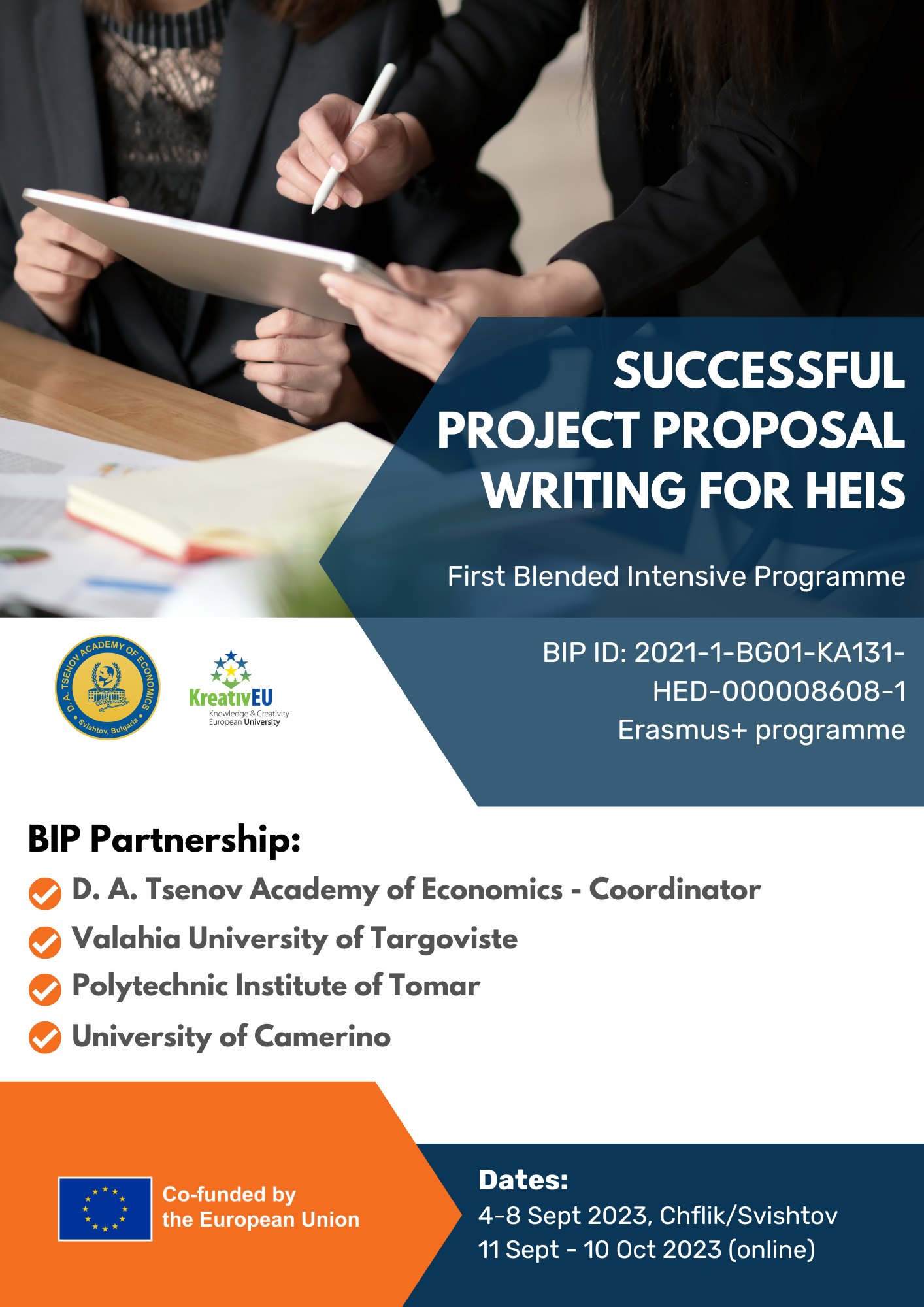
Blended Intensive Programme in Successful Project Proposal Writing for HEIs is aimed at equipping participants with the key skills and competences for designing successful project proposals. The BIP is targeted to the academic and administrative staff in HEIs, who are responsible for developing project proposals.
The BIP emphasises on designing and submitting successful project proposals under the calls of the Key Action 2 of the Erasmus+ Programme. The BIP content covers topics which vary from finding the right call for a project idea, developing a project concept, finding reliable partners, elaborating work packages and assigning responsible partners for each of the work packages, designing an implementation and risk management plan, as well as a dissemination and exploitation plan, constructing a budget, etc.
The BIP is more applied-oriented and use-inspired focusing on tips and guidelines both on how to create and evaluate/score a project proposal. It is focused on the evaluation criteria and what the evaluators look for in a project proposal under a specific call.
Expected outcomes and used methods:This BIP relies mainly on the project-based learning, small-group discussions and role-playing instructional approaches. Participants could learn through collaboration and experiences. They will work in small groups on a real project proposal and its work packages. Each group will evaluate a work package developed by a peer group.
By the end of the BIP, participants will be able to:
- find the right call for their project idea in order to increase their chances for funding,
- develop a project concept,
- find reliable partners by considering their expertise and capacity,
- create work packages and assign partners for each of the work packages,
- design an implementation and risk management plan,
- design a dissemination and exploitation plan,
- construct a budget,
- evaluate and score their project proposal before submission.
Participants will be able to find the right call for their project idea, develop a project concept, design implementation, risk management, dissemination, and exploitation plans, construct a budget, evaluate their project proposal, etc.
Physical component description:
Physical training will be held from 4th to 8th of September 2023 in Chiflik and Svishtov (Bulgaria).
Virtual component description:
After the physical training, participants will continue working on their group assignment – to complete the work package of a real project proposal assigned to their group during the physical training sessions by considering the feedback of a peer group.
The period of the virtual part is from 11 September to 10 October 2023.
BIP partnership:
D. A. Tsenov Academy of Economics (Svishtov, Bulgaria) - Coordinator, Receiving HEI
Valahia University of Targoviste (Valahia, Romania) - Partner, Sending HEI
Polytechnic Institute of Tomar (Tomar, Portugal) - Partner, Sending HEI
- Trainer: Margarita Bogdanova
- Trainer: Evelina Parashkevova-Velikova
- Trainer: Marusya Smokova